When I got out of prison, I ran to my father’s house… and learned the truth was buried somewhere else.
The first breath of freedom didn’t feel like freedom.
It tasted like diesel exhaust, cheap coffee, and the metallic air of a bus station at dawn—like the world had moved on without bothering to wait for me. I walked out of the gate with a plastic bag that held everything I owned: two shirts, a worn paperback, and the kind of silence you collect after years of being told your words don’t matter.
But I wasn’t thinking about the past.
I was thinking about one thing.
My father.
Every night inside, I had pictured him in the same place: sitting in his old armchair by the window, the light from the porch lamp washing over the familiar lines of his face. In my head, he was always waiting. Always alive. Always holding the version of me that existed before the courts, before the headlines, before the world decided I was guilty.
I didn’t stop to eat. I didn’t call anyone. I didn’t even check the little paper with the reentry office address.
I went straight home.
Or what I thought was home.
The bus dropped me three blocks away. I ran the last stretch, lungs burning, heart pounding like it was trying to make up for lost years. The street looked mostly the same—same cracked sidewalks, same maple tree leaning over the corner. But as I got closer, the details started to feel wrong.
The porch railing was still there, but the paint was fresher. The flower beds were different. New cars filled the driveway, shiny and unfamiliar, like the house had been claimed by a life I’d never been invited into.
I slowed down.
Still, I walked up the steps.
The door was no longer the dull navy my father had picked because “it hides the dirt.” Now it was an expensive-looking charcoal gray. And where the welcome mat used to be—plain brown, always crooked—there was a fancy one with clean lettering:
HOME SWEET HOME
I knocked anyway.
Not politely.
Not carefully.
I knocked like a son who had been counting down days, like someone who had a right to be there.
The door opened, and the warmth I’d imagined didn’t come rushing out.
Linda stood there.
My stepmother.
Her hair was styled like she’d just come back from a salon. Her blouse looked crisp. And her eyes—those sharp, measured eyes—scanned me from head to toe like I was a problem arriving on schedule.
For one second, I thought she might flinch.
Or soften.
Or at least look surprised.
Instead, her expression stayed flat.
“You’re out,” she said, like she’d just read it on the weather report.
“Where’s my dad?” My voice sounded strange, too loud in the quiet of that porch.
Linda’s mouth tightened, almost like she was annoyed I’d asked.
Then she said, calmly and coldly, “Your father was buried a year ago.”
The words didn’t land right.
Buried. A year ago.
The sentence made no sense, like someone had switched languages in the middle. My mind tried to reject it. I waited for the punchline. The correction. The cruel joke.
But Linda didn’t blink.
“We live here now,” she added. “So… you should go.”
My throat went dry.
“I—” I tried again. “Why didn’t anyone tell me?”
Linda’s lips curved slightly, not a smile—more like satisfaction.
“You were in prison,” she said. “What were we supposed to do? Send you a sympathy card?”
Behind her, the hallway looked changed. Different pictures on the walls. Different furniture visible beyond the entryway. None of my father’s things. No hunting coat hung by the door. No scuffed boots. No familiar smell of cedar and coffee and the lemon cleaner he used on weekends.
It was like my father had been erased.
And Linda was standing in the doorway guarding the eraser.
“I need to see him,” I said, voice cracking. “I need—”
“There’s nothing to see,” she replied. “It’s over.”
Then, before I could force another word out, she closed the door.
Not slammed.
Just closed—slow, deliberate—like she was ending a conversation she’d been tired of for a long time.
I stood there staring at the door, my hand still raised from knocking, like my body hadn’t caught up to what my life had just become.
A year.
My father had been dead for a year.
And I was finding out on a porch like a stranger.
I didn’t remember walking away.
I only remember the street tilting slightly, like the whole neighborhood had shifted on its foundation. I walked until my legs hurt, until my mind stopped trying to make the sentence “your father was buried a year ago” sound less final.
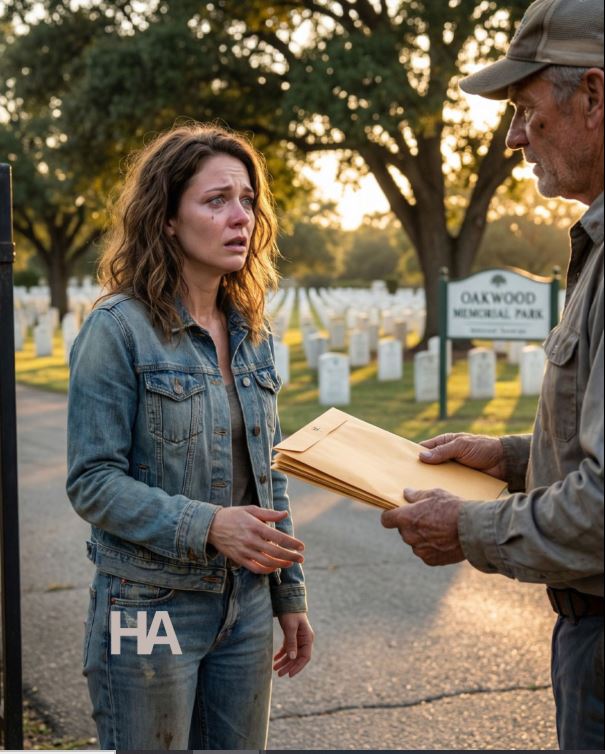
Eventually, I ended up at the only place that made sense.

